Installed in 2025
Singapore reached the original 2030 solar target five years early.

Singapore has become one of the world's most solar-dense cities. The next step is to turn more of the built environment itself into local generation — façades, glazing and other urban surfaces already surrounding electricity demand.
Explore Singapore in Solar Studio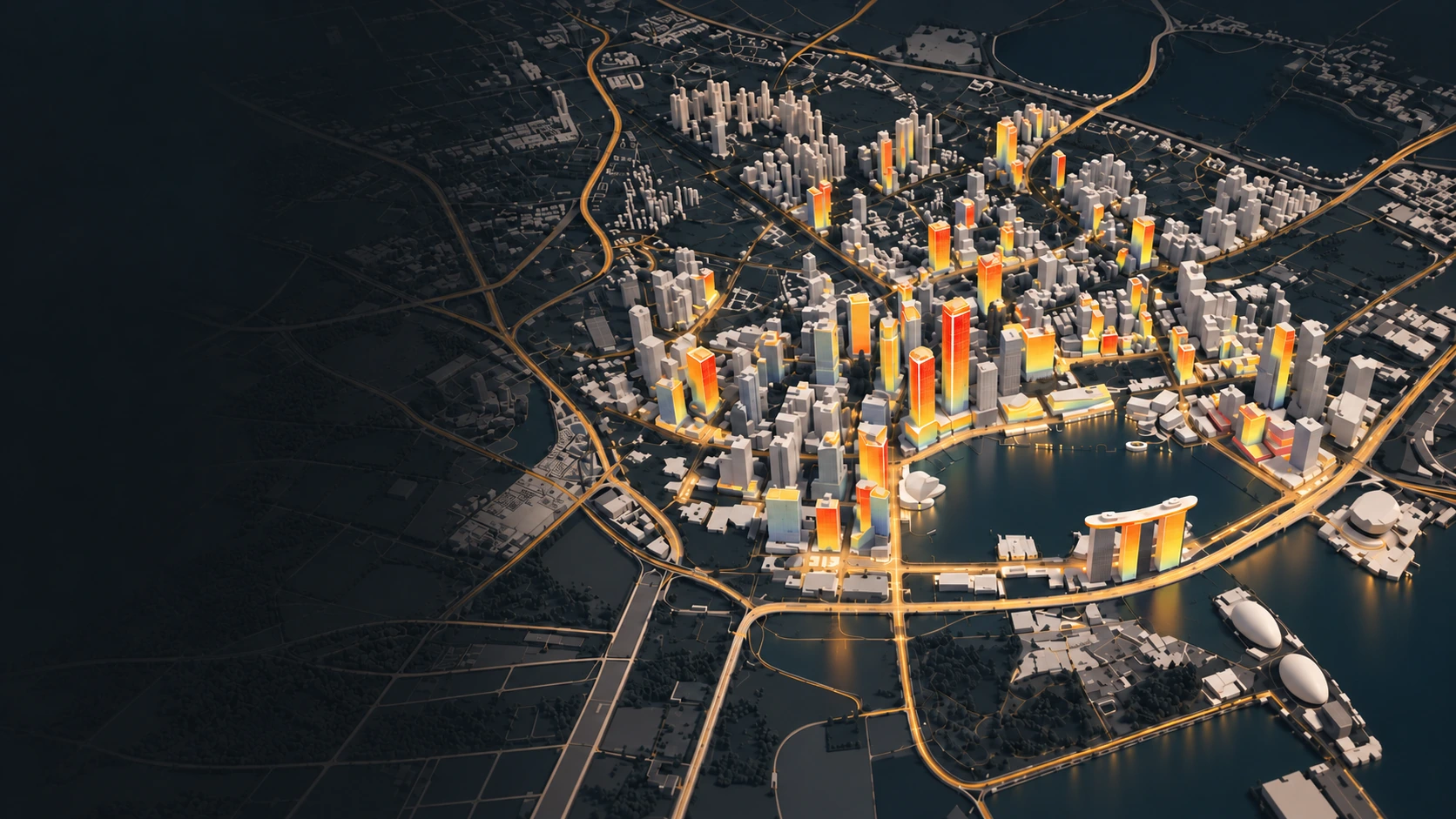
Singapore reached 2 GWp of installed solar capacity in 2025 and has raised its 2030 target to 3 GWp. More than 80% of current installed solar capacity is rooftop-based. That success makes the next question obvious: where does the next increment of urban solar go?
Singapore reached the original 2030 solar target five years early.
The new target requires continued deployment across every viable urban surface.
Rooftops dominate installed capacity today, leaving the building envelope as an underused opportunity.
Singapore's Green Building Masterplan targets at least 80% of buildings by gross floor area to be green by 2030. By 2026, around 66% had been greened. For owners and asset managers, the direction of travel is clear: buildings are expected to become progressively more energy-efficient and lower-carbon.
Façade solar adds a generation pathway that does not compete for new land. It uses surfaces already embedded in the city and can place generation close to daytime commercial loads.
Singapore's second Data Centre Call for Application makes at least 200 MW of additional capacity available and requires new projects to maximise green energy. Its eligible pathways explicitly include vertical building-integrated and building-applied photovoltaics.
Singapore is expanding AI and data-centre infrastructure while tightening energy-efficiency and sustainability requirements.
Government policy already recognises vertical BIPV/BAPV as one of the eligible green-energy pathways for data-centre growth.
Commercial towers, campuses and large assets offer extensive envelope area that rooftop-only strategies cannot access.
Generation at the building can complement imported power, grid electricity and rooftop PV as part of a diversified energy strategy.
Sydsol's Solar Studio is built to translate the macro opportunity into a property-level assessment: façade geometry, orientation, shading, usable surface, expected generation and economics.
For a building owner, the useful question is not “How much solar could Singapore deploy?” It is “What can this building generate, and what is the commercial case?”
Assess your buildingWhy compute growth is increasingly constrained by electricity infrastructure.
ENERGY SECURITYWhy on-site generation is becoming a strategic asset for buildings and cities.
BUILDINGSHow solar façades expand the usable area for distributed generation.
Please rotate your phone
to portrait